
70% of Shopify Carts Abandoned? Here's How Real-Time AI Intervention Saves Those Sales

That shopping cart sitting there with $150 worth of products? There's a 70% chance it's about to become another abandoned cart statistic. According to the Baymard Institute's latest research, the average cart abandonment rate across e-commerce hovers right around 70.22%, with Shopify stores experiencing rates between 60-80%.
But here's what's wild: most businesses are still fighting this problem with yesterday's tools. They're sending follow-up emails hours or days later, hoping to resurrect interest that's already gone cold. Meanwhile, AI-powered real-time intervention is quietly recovering 28-45% of those "lost" sales by catching customers before they even leave.
Why Traditional Cart Recovery Falls Short
The typical cart recovery playbook looks something like this: customer abandons cart, wait 1-3 hours, send email reminder, maybe follow up with a discount code a day later. It's reactive, slow, and treats the symptom instead of the cause.
The problem runs deeper than timing. Mobile abandonment rates hit 77.08% compared to just 62.04% on desktop. When someone's shopping on their phone at a red light or between meetings, they're not coming back to check email later. The moment is gone.
Traditional methods also miss the psychological reality of abandonment. According to research, 23% of customers abandon because the checkout process was too long or complicated, 18% because of unexpected costs, and 17% due to security concerns. Email reminders don't solve any of these friction points.
How Real-Time AI Intervention Changes the Game
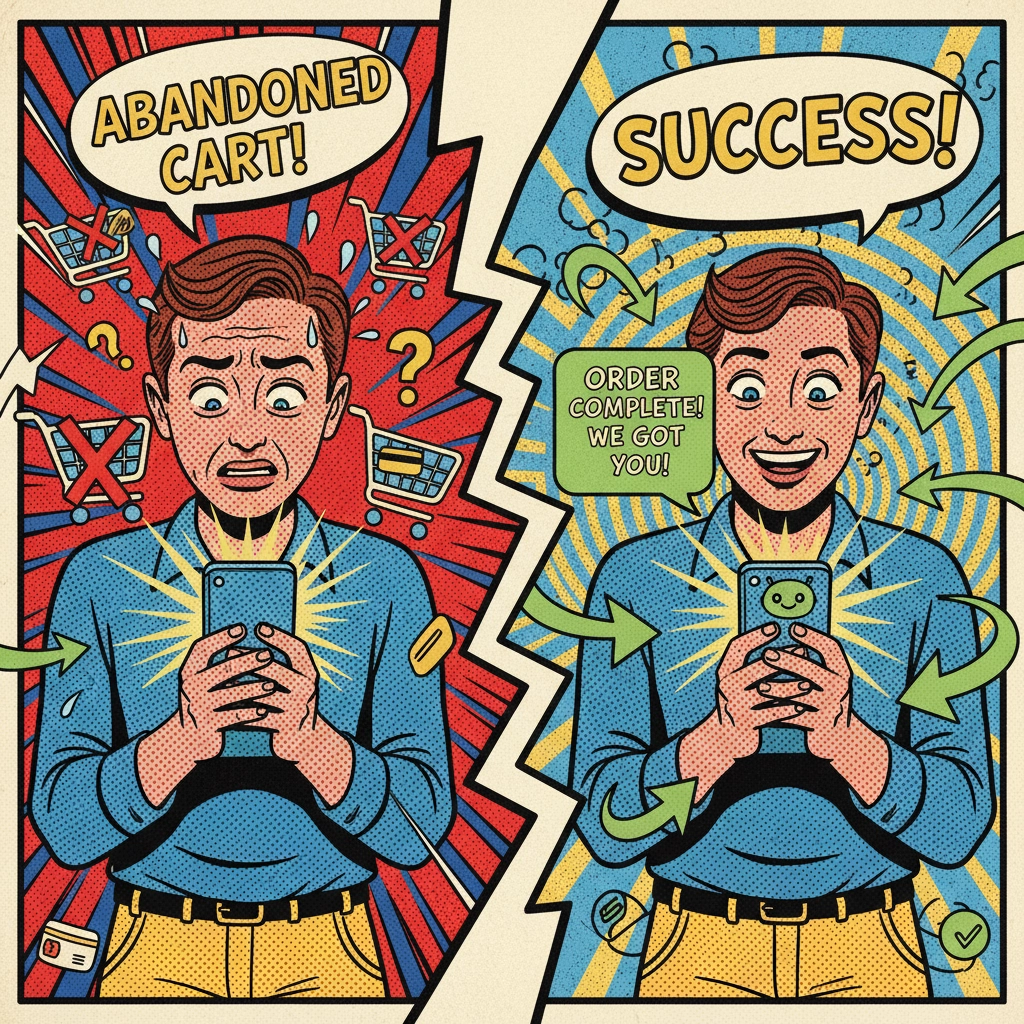
Real-time AI intervention flips the script entirely. Instead of waiting for abandonment to happen, these systems predict it and intervene while the customer is still engaged.
Here's how it works: AI monitors behavioral signals like idle time, cursor movement patterns, exit intent triggers, and scrolling behavior. When the system detects high abandonment probability, it deploys immediate interventions - smart pop-ups with personalized offers, live chat assistance, or SMS messages before the customer leaves the site.
Take CartKeeper, for example. Their AI detects when checkout goes inactive and instantly reaches out via WhatsApp with conversations that mimic store owner communication. The AI handles shipping questions, returns policies, and payment concerns, allowing customers to complete purchases directly in chat.
The difference in effectiveness is dramatic. While traditional email sequences typically recover 10-15% of abandoned carts, real-time AI intervention achieves recovery rates of 28-45% across hundreds of stores.
The Arsenal: AI Techniques That Actually Work
Predictive Exit Intent Detection
Advanced AI goes beyond simple mouse movement tracking. It analyzes dozens of micro-signals including time spent on checkout fields, form completion patterns, and even typing speed to predict abandonment risk with 85%+ accuracy.
Contextual Messaging
Instead of generic "You forgot something" emails, AI crafts messages based on specific cart contents, browsing history, and customer behavior. A customer hesitating over a high-ticket item gets different messaging than someone stuck on shipping costs.
Multi-Channel Orchestration
The best systems don't rely on a single touchpoint. They might start with an on-site pop-up, follow with SMS for mobile users, and back it up with personalized email - all coordinated through AI to avoid message fatigue.
Dynamic Incentive Optimization
AI tests different offer types (percentage discounts, free shipping, buy-one-get-one) and amounts based on individual customer value and abandonment triggers. A price-sensitive customer might see a 15% discount, while someone concerned about shipping gets free delivery.

The Numbers Don't Lie: Real Recovery Results
Let's talk hard numbers. CartKeeper reports recovering $2.4 million in sales across 780+ stores, with individual businesses seeing 20-40% increases in checkout completion rates.
For perspective: if your Shopify store processes 1,000 carts monthly with a $100 average order value, you're looking at approximately 700 abandoned carts worth $70,000. Recovering just 25% of those through AI intervention adds $17,500 monthly - that's $210,000 annually.
The ROI calculation becomes even more compelling when you consider customer lifetime value. These aren't cold prospects you're trying to convert - they're warm leads who already demonstrated purchase intent. You're just removing the final barriers.
Beyond Recovery: The Personalization Advantage
Modern AI agents do more than send reminders. They provide genuine value by addressing specific concerns in real-time. Language barriers? The AI automatically translates conversations. Product questions? It accesses your entire catalog to provide detailed answers. Shipping concerns? It calculates exact delivery dates based on location.
This level of personalization matters because customers don't actually care whether they're talking to AI or humans - they care about getting accurate, helpful responses quickly. When AI can provide better, faster service than traditional support channels, customer satisfaction increases alongside conversion rates.
The systems also learn and improve over time. Machine learning algorithms continuously optimize message timing, format preferences (email vs SMS vs chat), and incentive amounts based on what works for different customer segments.
Implementation Reality Check
Rolling out real-time AI intervention isn't as complex as it sounds. Most solutions integrate directly with Shopify through apps or APIs, requiring minimal technical setup. The key is choosing systems that offer:
Real-time behavioral tracking
Multi-channel messaging capabilities
A/B testing and optimization features
Detailed analytics and reporting
Transparent pricing based on results
Cost structures typically range from $19-99 monthly based on actual recoveries rather than conversation volume, making ROI calculations straightforward.
However, the real strategic shift is thinking about cart recovery as leak prevention rather than lead generation. When 89% of website visitors leave without purchasing, fixing conversion issues often delivers better returns than simply driving more traffic.
The Bigger Picture: Database Gold Mine
Cart abandonment is just the tip of the iceberg. Most businesses sit on databases full of customers who showed interest but never converted - or converted once and disappeared. The same AI principles that recover abandoned carts can reactivate entire databases, often pulling 5-6 figures from "dead" leads.
This shift toward database reactivation and retention makes particular sense in 2025's economic climate. Customer acquisition costs keep climbing while AI makes sophisticated retention strategies accessible to businesses of all sizes.
Key Takeaways
The 70% cart abandonment rate isn't inevitable - it's solvable. Real-time AI intervention represents a fundamental upgrade from reactive recovery to proactive prevention. The technology exists, the results are proven, and the ROI justifies immediate implementation.
Start by auditing your current cart abandonment rate and recovery performance. If you're relying solely on email sequences sent hours after abandonment, you're leaving serious money on the table. The customers are there, the technology works, and every day without real-time intervention means more lost sales.
The question isn't whether AI can recover abandoned carts - it's whether you can afford to keep losing 70% of them while your competitors are already saving theirs.
Comments